There are a few stories in the news lately that are troubling me:
There's the General Petraeus resignation... the now-cliché story of a powerful man taken down by a sex scandal. And aside from an affair being cited for the resignation, the timing is also being questioned because he was supposed to be part of key testimony for the Benghazi trial.
Then as I was looking for the latest on that story, I came across accusations against Sesame Street and Elmo puppeteer Kevin Clash alleging an inappropriate relationship with underage male. And the BBC sex scandal. I'll go as far to call these two cliché too, after the many stories of child sex abuse i.e. Catholic priests and Penn State/Sandusky.
Must I say anything about the recent election and the topic of reproductive health and rape?
And we have the Zumba Prostitution Scandal, as it is being referred to in the news. Also not so unfamiliar.
Also the story we've all seen on the 11 o'clock news if you've ever watched it - the man-jumps-out-of-nowhere-late-at-night-or-in-broad-day-light-to-attack-a-woman story, like this one being reported in Boston.
I'll also throw in the fact that the number of registed sex offenders is increasing (although I have heard arguments debating the reasons behind the increase).
WHAT IS UP WITH ALL THIS!?
While all these stories are very different - they are all tied together by SEX. There are also so many more stories that I haven't included that are part of the same thread but these are the ones that I've been seeing and hearing about recently.
But really, what do we make of all this? I can barely wrap my head around it all.
Are these issues unique to the US? If not, how are they handled, included how/if they are reported (and/or glamorized) in other countries?
How do we explain these things to our children?
What can we take and learn? Is change possible?
What is the role of morality (personal and cultural/societal) in these stories?
These are the stories of today, but they are far from new and I can sadly say with confidence that it won't be the last time we see more like them.
Showing posts with label Society and Culture. Show all posts
Showing posts with label Society and Culture. Show all posts
Monday, November 12, 2012

Sunday, July 31, 2011
Love-making (not sex?!) sells???
 While I don't have TV in my apartment, I do have a subscription to People magazine. As soon as I opened the latest issue, I must admit, I was rather appalled at a two-page Dolce & Gabbana cologne ad that highlights a guy's "package"... (okay, I'm not going to pretend I don't like a little eye-candy but REALLY??? Maybe for an underwear ad... but cologne?!)... ->>>
...so I flip past and catch up on my celeb gossip and about half way through the mag, I was pleasantly surprised to see a two-page ad for KY (the sex lubricant) highlighting "America's Top Couple" winners with the following caption:
"What makes a couple stand out? For our annual content, we asked America to find that special relationship built on communication, trust, and intimacy. Out of thousands of submissions, this winning couple embraced all of those qualities and so much more."

At a time when casual sex, affairs, celebrity break-ups and countless other scenarios of low-moral-value are nothing short of glamorized, it is refreshing to see a well-known brand championing committment. KY could easily grab attention in any number of ways, being a sex product, but they chose not to - potentially to their detriment, considering how well "sex sells". When's the last time you heard "romantic, committed love-making sells"?!
Seeing this ad and other campaigns such as Dove's highly successful Real Beauty campaign (which, ironically enough, was the next to last ad in this issue - something I realized after I posted this!) give me a glimmer of hope that our future generations will get a different prominent message than the morally-devoid sexuality that permiates pop culture today.

Tuesday, May 10, 2011
From "cool" to "uncool"...
...kind of how I'm feeling lately so had to repost this from Brené Brown's blog post "cool: the emotional straightjacket". Hoping to find some nice middle-ground at some point :) Because right now, I'm thinking, "how uncool is it to even post this on my blog" HA!
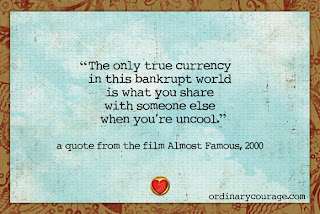
What has a decade of research on authenticity, shame, vulnerability and courage taught me about "being cool?"
1. The need to "be cool" is an emotional straightjacket. It keeps us from moving, growing, stretching and feeling free.
2. "Cool" and authentic are often mutually exclusive.
3. It takes courage to feel awkward, goofy, and silly - all of the feelings that we experience when we're brave enough to try something new or risk being innovative. This is so tough for me. My mantra when I'm trying something new and feeling awkward and goofy is "Effort + the courage to show up = enough."
4. The language of cool permeates our culture and sends messages to the people around us - especially our children. Try boycotting words like LAME, UNCOOL, and LOSER. Also, there is an entire collection of words that are used as cool armour by vulnerable teens and tweens (and adults). They include words like retard, retarded, bitch, fag, and queer. Trying to come off as cool and indifferent often leads to the use of hate language.
5. The greatest casualty of the endless pursuit of cool is connection. When we don't let people see and know our true selves, we sacrifice connection. Without connection, we struggle for purpose and meaning.
Have a great week, be connected, and becoolyou.
Repost from ordinarycourage.com
Saturday, April 23, 2011
"I'm sick of the bar scene"
I first dabbled in online dating back in 2005, WAY before it was socially acceptable to admit. I'm not even sure it is today? Anyways, I did it then and I am doing it again now. And it has me thinking on this rainy Saturday morning. Pretty much every profile I read says something along the lines of:
I'm not sure which seems like more of a risk - meeting people while either both or one of you is intoxicated and displaying some watered down (or over-exaggerated, depending on what kind of drunk you/they are) version of yourselves...
OR...
the internet, where everyone puts their ideal versions of themselves in 3000 characters or less, which inevitably leads to disappointment on both sides.
I'm inclined to read back in history or take a survey of older generations to see how they met their partners. And maybe take a survey in other countries too. Because being 20-something and living around Boston since I entered my 20's - this is all I have been exposed to in terms of how to meet new people... drinking establishments and the internet. There was college and there is work - but in both, the social aspect of each always involved a drinking establishment. And I don't go to church. And I know there are these social activity clubs but where do you find people for those... on the internet.
Maybe I just need to accept the times we live in today. I definitely need to find a hobby, I suppose. But I'd really prefer to understand all of the alternatives too. If there are any...
I never thought I would do online dating but I am sick of the bar/club scene so here I amAre drinking establishments and the internet really the only two options people consider viable meeting places for potential partners? REALLY?
I'm not sure which seems like more of a risk - meeting people while either both or one of you is intoxicated and displaying some watered down (or over-exaggerated, depending on what kind of drunk you/they are) version of yourselves...
OR...
the internet, where everyone puts their ideal versions of themselves in 3000 characters or less, which inevitably leads to disappointment on both sides.
I'm inclined to read back in history or take a survey of older generations to see how they met their partners. And maybe take a survey in other countries too. Because being 20-something and living around Boston since I entered my 20's - this is all I have been exposed to in terms of how to meet new people... drinking establishments and the internet. There was college and there is work - but in both, the social aspect of each always involved a drinking establishment. And I don't go to church. And I know there are these social activity clubs but where do you find people for those... on the internet.
Maybe I just need to accept the times we live in today. I definitely need to find a hobby, I suppose. But I'd really prefer to understand all of the alternatives too. If there are any...
Wednesday, April 20, 2011
Easter
Easter is approaching this coming weekend. Today, while completely distracted at work, I was wondering: what on earth is the connection between pastel colored eggs, candy, a bunny and the resurrection of Christ and the term Easter. The rest of the typical holidays are a little more straightforward... this one, not so much.
How did a bunch of stuff with such scattered origins become a main staple of what is, apparently, the biggest Christian holiday? Am I the only one baffled by this? I'm afraid to do the same research on Christmas, which I have yet to do.
Sometimes, like now, I think that maybe it's better not to question things so much!
1 http://www.history.com/topics/history-of-easter
2 "Easter," Encyclopedia Britannica
3 "Feasts and Saints of the Orthodox Church: July 22," Orthodox Church in America, at: http://www.oca.org/
Why is it called Easter?
- The exact origins of this religious feast day's name are unknown. Some sources claim the word Easter is derived from Eostre, a Teutonic goddess of spring and fertility. Other accounts trace Easter to the Latin term hebdomada alba, or white week, an ancient reference to Easter week and the white clothing donned by people who were baptized during that time. Through a translation error, the term later appeared as esostarum in Old High German, which eventually became Easter in English 1
Where did Easter Rabbits and Eggs Comes From?
- The symbols of the Norse Goddess Ostara were the hare and the egg. Both represented fertility. From these, we have inherited the customs and symbols of the Easter egg and Easter rabbit.
- Dyed eggs also formed part of the rituals of the ancient, pre-Christian Babylonian mystery religions. "The egg as a symbol of fertility and of renewed life goes back to the ancient Egyptians and Persians, who had also the custom of coloring and eating eggs during their spring festival." 2
- "Like the Easter egg, the Easter hare came to Christianity from antiquity. The hare is associated with the moon in the legends of ancient Egypt and other peoples....Through the fact that the Egyptian word for hare, UM, means also "open" and "period," that hare came to be associated with the idea of periodicity, both lunar and human, and with the beginning of new life in both the young man and young woman, and so a symbol of fertility and of the renewal of life. As such, the hare became linked with Easter...eggs." 2
- Christian tradition states that when Mary Magdalene visited Emperor Tiberias (14 - 37 CE), she gave him a red egg as a symbol of the Resurrection -- a symbol of new life. Some believe that the Christian tradition of giving eggs to each other at Easter time came from this event. 3
How did a bunch of stuff with such scattered origins become a main staple of what is, apparently, the biggest Christian holiday? Am I the only one baffled by this? I'm afraid to do the same research on Christmas, which I have yet to do.
Sometimes, like now, I think that maybe it's better not to question things so much!
1 http://www.history.com/topics/history-of-easter
2 "Easter," Encyclopedia Britannica
3 "Feasts and Saints of the Orthodox Church: July 22," Orthodox Church in America, at: http://www.oca.org/
Monday, April 18, 2011
A Lesson from the Lost Boys of Sudan
I watched this movie last night - God Grew Tired of Us: The Story of Lost Boys of Sudan. This clip of portions of the movie captures a perspective that I think is unrealized by many people.
What a fresh, raw look at American cultural norms. So many things we just accept as normal without question. These men are nothing short of admirable - from their will to survive as young boys escaping Sudan to their motivation to succeed when resettled in America, despite the continuous challenges. All while maintaining a sense of humor.
This movie encourages me to reevaluate my own judgements and preconceptions about both American and foreign cultures; and to continue to feed my cultural awareness. Not to mention how much more I appreciate the stability in my life.
What a fresh, raw look at American cultural norms. So many things we just accept as normal without question. These men are nothing short of admirable - from their will to survive as young boys escaping Sudan to their motivation to succeed when resettled in America, despite the continuous challenges. All while maintaining a sense of humor.
This movie encourages me to reevaluate my own judgements and preconceptions about both American and foreign cultures; and to continue to feed my cultural awareness. Not to mention how much more I appreciate the stability in my life.
Subscribe to:
Posts (Atom)